Under the Hood: Index Funds


A common piece of investing advice (and sometimes even financial planning advice) you may hear nowadays is just buy index funds. And we don’t hate it. We genuinely believe the index fund is one of the great financial innovations of all time, and it’s for good reason index funds are welcomed into conventional wisdom. Index funds have come a long way since 1976 when the first retail index fund launched, and today they shepherd multiple trillions of dollars. But the advice of just buy index funds is incomplete – we use them in our portfolio in service of our Clients’ needs, but we also use funds that don’t quite meet the definition of an index fund (and for good reason!). So, let’s get into what an index fund actually is, what’s going on inside the simple ticker you see, and why an understanding of how they work matters.
What Is an Index fund?
To start answering the questions we so neatly posed to ourselves, every index fund tracks an index. An index is simply a group of stocks held in different weights and rebalanced periodically according to rules an index provider writes. An index itself isn’t an investment product; it’s a measurement tool. The S&P 500, maybe the most recognizable index in the world, is maintained by a committee at S&P Dow Jones Indices. When an investment company decides to build a fund around that index, that’s when it becomes an investable product known as an index fund.
A More In-Depth Look Under the Hood of Index Funds
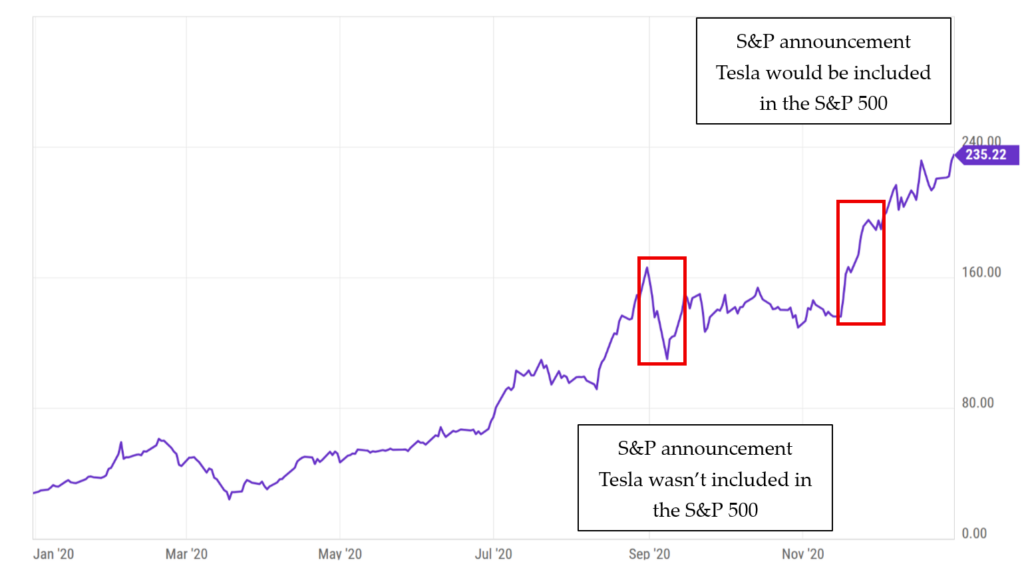
Most indexes are transparent enough and you can actually review their published criteria. Take the S&P 500 as an example — their methodology and US Equity indices are available online. To be included, a company must be US based, have positive earnings over the most recent four quarters, meet certain size thresholds, etc. Here’s where it gets interesting. At the end of the day, the S&P committee maintains discretion over what makes the index regardless of what the published criteria says. This discretion has caused a kerfuffle more than a few times. In 2020, Tesla met the published requirements in time for the S&P 500 Index’s September rebalance and yet they were added later in December instead (see chart below). This caused severe movements in Tesla’s stock price around both dates. And on the date they were added to the index, funds tracking the S&P needed to add billions of dollars’ worth of Tesla stock because when the index adds a stock, all funds following the index have an obligation to add that stock.
Compare the S&P 500 to the Russell 3000, another popular index tracking US companies created by FTSE Russell. Their methodology is purely rules based. Twice a year they rank US companies by market capitalization (the total value of available shares multiplied by the company’s stock price) and include the top 3,000 companies in terms of their value. No committee or discretion is required to create this list. So, when Tesla was added to the Russell 3000 in 2010, it was no surprise. Still, these are two indexes tracking similar companies, and yet they have different rules that govern their construction.
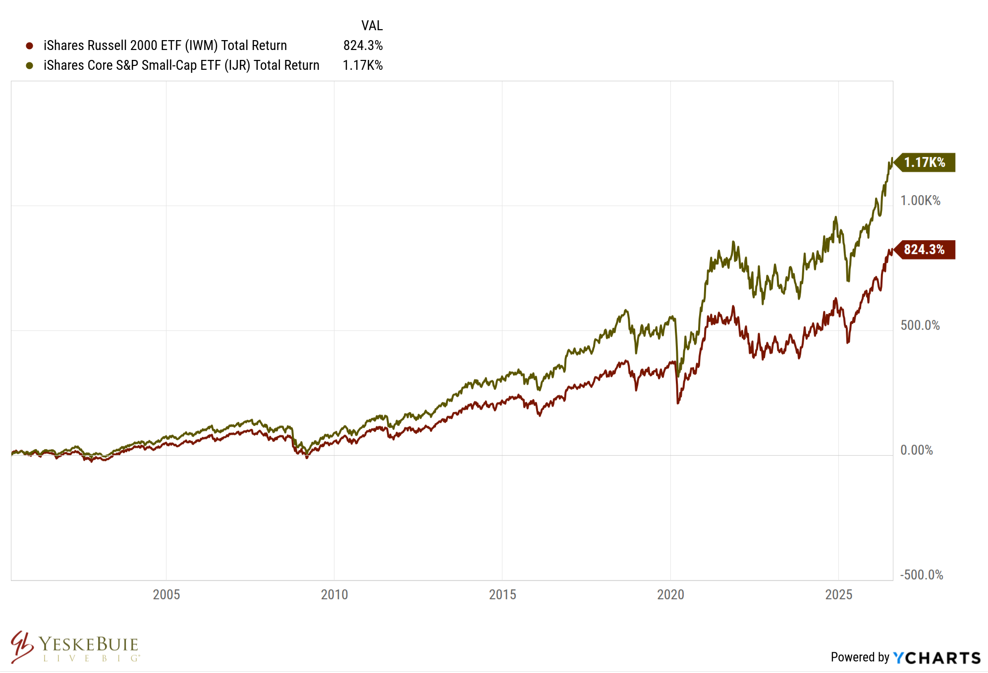
Large US companies are where the indexes have the most overlap. If we move to smaller companies, the differences start to matter more. S&P has the SmallCap 600 and FTSE Russell has the Russell 2000, two indexes that appear to be tracking the same corners of the market. Over the past 25 years, they’ve differed in performance by an average of 1.34 percentage points annually. Two index funds, tracking a similar asset class, yet yielding very different results.
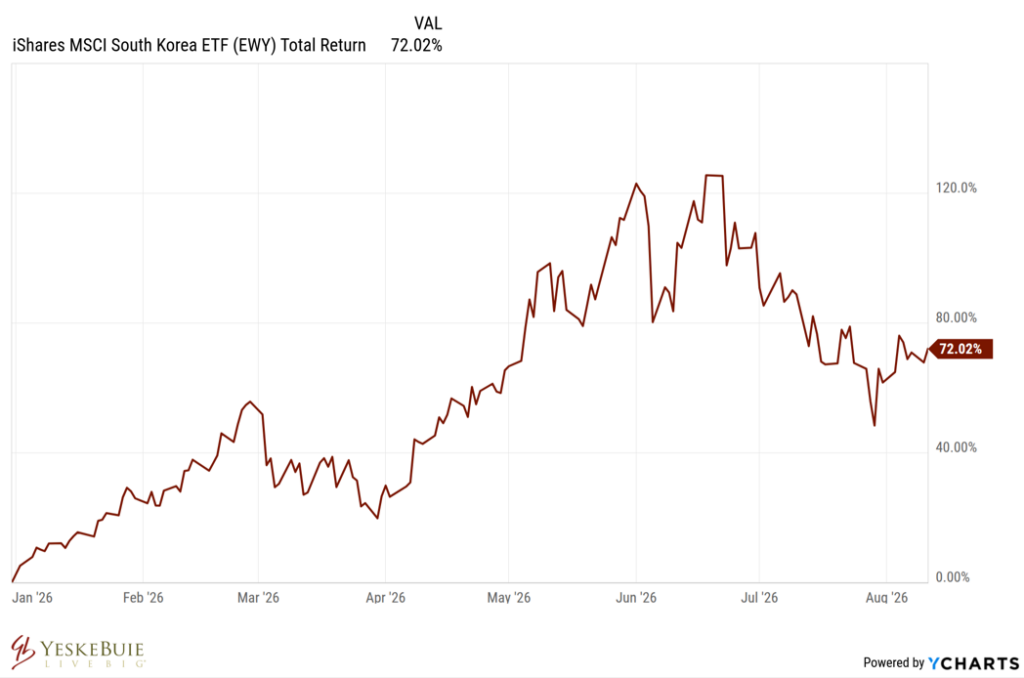
That’s just the US, one of the most liquid and followed markets in history. Once you go global, more quirks appear. MSCI and FTSE Russell, two of the major international index providers, can’t agree on which countries are “developed” and which are “emerging.” South Korea and Poland, for example, are classified as emerging markets by one provider and developed markets by the other. This has practical implications, too.
If you own an Emerging Markets Fund tracking MSCI’s index and a Developed Markets Fund tracking FTSE Russell’s Index, you own South Korea twice. Flip it and you own it zero times. So, two investors both attempting to be globally diversified can end up with meaningfully different portfolios without either of them knowing it. And since which country performs well in any given year is anybody’s guess, can you imagine not having South Korean exposure in your intentionally allocated, globally diversified portfolio through the first half of 2026?
Why This Matters
None of this is to mischaracterize what we think “just buy index funds” is actually trying to say. We think the advice is reaching for something profound: build a diversified portfolio in a low cost, tax efficient way that takes advantage of the fact that humans come together in markets to aggregate all known information into prices (a position we staunchly agree with). Index funds are a vehicle, though, not a destination. The right questions to ask on the investment side include:
- What are we trying to create?
- What funds are right to use for that purpose?
- How do these building blocks work together in service of our objectives?
For us, that’s a conversation that goes beyond index funds alone.
When a conversation about investment philosophy starts, oftentimes two schools of thought are introduced at the outset: passive and active. In a nutshell, a passive approach is designed to harness the market’s movements (or a segment of it), whereas an active approach aims to “beat” the market by outperforming it (and there is no evidence that anyone can do this consistently or reliably). Rather than think of these two approaches as binary, we instead think of them as two ends of a spectrum.
Passive investing has become synonymous with tracking an index. But, as we’ve seen, indexes have quirks, rules, and even some limitations baked in. What passive investing is really trying to say is something we wholeheartedly agree with: trust markets, don’t try to outsmart them, and own as much of them as you can. If you’re going to buy the haystack, buy the whole haystack. And if that haystack doesn’t quite get you to where you want to be, then expand your opportunity set. We use index funds when they are the best tool, and then we go beyond them for many of the same reasons we believe in them in the first place.
Let’s go further into that last statement. We want to be more diversified, not less, which is why index funds alone are incomplete. Take the Vanguard Total World Stock ETF as an example. It’s an index fund that tracks the FTSE Global All Cap Index and owns roughly 10,000 companies. (That is a lot of companies.) But that ETF is beholden to its index which means it can only own what the index tells it to own. Compare that to a fund like the DFA Global Equity Fund, which isn’t an index fund and owns closer to 15,000 companies. Funds like the DFA Global Equity Fund carry the “active” label, but that label can be misleading because DFA fund managers aren’t stock pickers nor are they making active bets on individual companies. They simply aren’t constrained by someone else’s list which means, in this case, they can reach smaller, more regional companies that index funds are structurally unable to own. Their approach is still one that is focused on harnessing the market rather than beating it, but they’re able to be more flexible and use evidence-based approaches to enhancing their funds in ways traditional index funds simply cannot explore because they’re beholden to their respective index.
Bringing This All Home
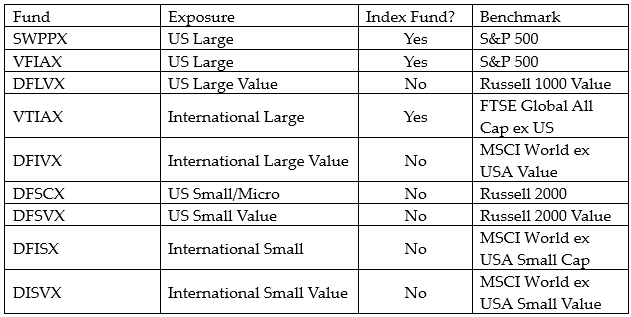
We’ll emphasize it again: we believe the index fund is one of the greatest financial innovations of all time. They’re a great way to get invested and diversified, which already accomplishes so much. For our purposes, they’re tools, and below you can see which index funds we use in your portfolio, alongside the non-index funds we pair them with. But not every investing problem is a nail waiting to be solved with a hammer, though you’d hate to build anything without a hammer. You’ve heard us talk about deep regularities in the market, specifically the way Small Companies and Value Companies have outperformed their counterparts when looked at over long periods of time. So, if we know these exist, why not add a screwdriver to our toolkit? We want to use funds that can emphasize those directly, which means more specific exposure. The goal underneath it all is not to just buy index funds (that’s much too simple!); it’s to build a diversified portfolio that takes advantage of what markets reliably offer. Index funds get us most of the way there, and we use them gladly when they’re the tool for the job. But if we can build something more diversified that harnesses all the power that markets bring to bear, we’re not going to let the conventional wisdom or an Index’s list stop us!