
Seeds of Savings: The 530A Account Explained


For anyone with children (or nieces/nephews/friends-turned-family), it can be hard to think ahead and picture them growing into adults, imagining who they might be and what their life might be like. And yet we think about these phases of their life often in the financial planning process – from considering funding Custodial accounts for their future personal needs to saving in 529s to support their educational endeavors, we’re often thinking about supporting those sweet babies and toddlers many years from now.
And Section 530A accounts (aka Trump Accounts) may be one additional way to do so. While there remains a decent amount of implementation detail to be clarified by the IRS, we’re writing today to share what is currently known and the parameters to be aware of as these accounts become a reality on 7/4/2026.
We will continue to watch for clarifications and update you in this space and in our coming webinar, Stormy Skies, Clear Strategy. For now, as it stands today, read on to learn more about the…
Why | What | Who | When | How | Where | What Else
Be sure to pay special attention to the What Else section – some big questions remain!
Why
- “To jumpstart the American Dream.”
- These accounts will provide an early jumpstart to retirement savings for any child under 18.
What
- Created by Section 530A of the Internal Revenue Code, 530A Accounts (also known as Trump Accounts) are a type of Individual Retirement Account (IRA) for eligible children under the age of 18.
- Contributions can begin as of July 4, 2026 (so actually on the next business day, July 6, 2026).
- Like traditional IRAs, earnings on any contributions grow tax-deferred.
Who
- Account beneficiary:
- Child under the age of 18 at the end of the year the election is filed, must be a U.S. Citizen and have a valid SSN,
- Account opener/owner:
- The parent or guardian will be the most likely person to open the account for the child (though adult siblings and grandparents can also open accounts). Each child can only have one account.
- Contributors:
- Parents, guardians, grandparents, and others can all contribute to the account up to the annual maximum ($5,000 per account). These contributions are not tax deductible for the contributor.
- The US Treasury will contribute $1,000 for babies born 1/1/25 – 12/31/28.
- Account owners’ employers can contribute up to $2,500 per year, which is included in the overall $5,000 annual max.
- These contributions are not taxable to employees and are tax deductible to the employer.
When & How
- Open:
- Make the election when filing your 2025 (or future) tax return (file Form 4547 with your return).
- File the Form 4547 separately/standalone via paper or electronically.
- Apply anytime at www.trumpaccounts.gov.
- Contribute:
- Beginning 7/4/2026, up to $5,000 can be contributed each year until the child turns 18.
- Unlike traditional IRAs, there is no requirement for the child to have earned income to have contributions made to the account.
- The total annual contributions from all parent/family/employer sources cannot exceed $5,000 per account/child.
- The one-time seed deposit by the US Treasury ($1,000) is in addition to this $5,000 annual maximum.
- Contributions made be federal or state governments or charitable organizations do not count toward the annual $5,000 maximum.
- Beginning 7/4/2026, up to $5,000 can be contributed each year until the child turns 18.
- Invest:
- The funds contributed will be required to be invested in an index fund comprised mostly of U.S. stocks (exact fund options remain to be seen).
- Distribute:
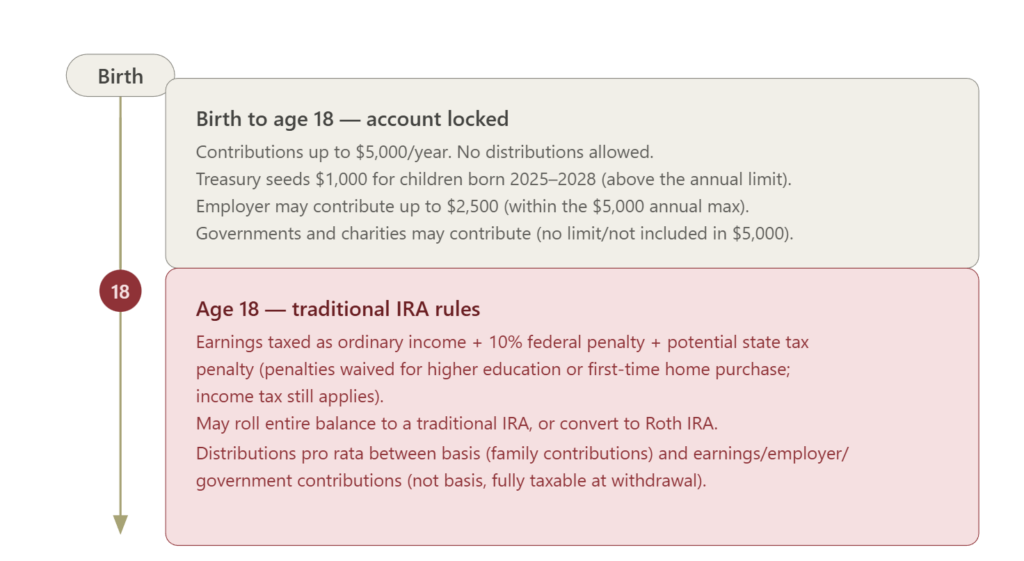
- No distributions are allowed before 18. At age 18, the 530A accounts will essentially be treated as traditional IRAs.
- All earnings are subject to tax at withdrawal. Like IRAs, if withdrawn before age 59.5, penalties (federal and, potentially, state) will also apply (exceptions below).
- Family contributions (basis) are tax-free at withdrawal. Employer/government contributions are taxed as earnings.
- Each withdrawal is pro-rata (example: $10,000 account, $5,000 basis, $5,000 earnings. Each withdrawal will be 50% taxable, plus any applicable penalties).
- The only exceptions to the 10% federal penalty on early withdrawals before age 59.5 (plus 2.5% California state tax penalty if you live in CA) are the same for traditional IRAs (first-time home buyers, higher education, disability, 72(t) distributions, birth/adoption, etc.)
- Similar to IRAs, funds in these accounts could also be converted to Roth IRA (tax owed, no penalties) starting at age 18 (and then grow tax-free forever in the Roth IRA).
Where
- It remains to be seen which custodians will house these accounts.
What else should I be aware of at this time?
- A lot remains to be clarified by the IRS and by state tax legislation. It’s possible there will be ongoing legislative changes to fine-tune the rules for these accounts.
- A few questions on our minds:
- Which custodians will be housing these accounts?
- What will the investment options be?
- Who will be responsible for tracking contributions (which add to basis) and earnings (tax-deferred, taxable at withdrawal)?
- Note that parent/family contributions create basis in the account; employer and government contributions do not and will be fully taxable at withdrawal.
- How might state tax differences affect the pros/cons of these accounts? For example, California often doesn’t comply with all federal tax law changes, and it appears employer contributions will be considered taxable income and investment earnings may be subject to the kiddie tax rules at the state level in California.
-
- Currently, it appears these annual family contributions will not qualify as part of the annual gift tax exemption. Will contributors need to file a gift tax return every year they contribute?
Overall, although there remains to be a lot clarified (which tends to be the case with major tax law change or new initiatives), these Section 530A Accounts could be an interesting early saving mechanism for your children/grandchildren/loved young family members. We’ll continue to monitor for updates and would love to think through your family’s situation together – We’re Good People To Think With!®