
Seeds of Savings: The 530A Account Explained — Part 2


As of July 4th, 2026, these 530A Accounts (aka Trump Accounts) are now open for business! As we previously shared, they are retirement accounts that can be opened and funded for children under 18. There are special rules to be aware of, limited investment options, and still a few unknowns. But if you’ve recently been wondering if you should consider opening one of these accounts for your child or grandchild, read on.
A Brief Recap
To offer a brief recap, Section 530A accounts can now be opened for any U.S. citizen child under the age of 18. If the child was/is born between 1/1/2025 – 12/31/2028, the U.S. Treasury will provide a $1,000 seed contribution to the account. The accounts can be opened online or when filing your next tax return. And these accounts can have contributions made up to $5,000 per year (this maximum limit will adjust for inflation starting in 2028), which can include up to $2,500 per year from your employer if they offer this benefit. If you want to refresh your memory on the requirements, contribution details, and more, see our original piece here.
While these accounts were created as part of the One Big Beautiful Bill Act, there was still much to be learned as the account opening date approached. And, as with many major tax law changes, more has come to light recently and is still being determined by the Treasury and the IRS.
Recent Updates
Now that the accounts are “open for business” and millions of them are in existence, we’ve learned more about where they can be accessed, the funds allowed, and the most recent tax updates in the state of California.
Access
- For now, the accounts are accessed through TrumpAccounts.gov and the corresponding app (versus directly through any custodian like Schwab or Fidelity).
Investments
- While this is a still-developing topic, we have some initial clarification. It was originally made clear that the investment options allowed in these accounts would be low-cost index funds tracking major U.S. stocks. It has been clarified that:
- The default initial fund for investment is the State Street SPDR Portfolio S&P 500 ETF (SPYM)
- Four additional funds should be available soon:
- iShares Core S&P 500 ETF (IVV)
- Vanguard Total Stock Market ETF (VTI)
- State Street SPDR Portfolio S&P 1500 Composite Stock Market ETF (SPTM)
- iShares Core S&P Total U.S. Stock Market ETF (ITOT)
- It’s also been made clear that there will be no ESG (environmental, social, governance) funds available in these accounts.
- As you might be thinking, these funds, unfortunately, do not provide any possible international stock exposure nor do they provide the ability to overweight small company or value stock exposure. You may realize that’s not in alignment with our investment philosophy. As with all things, we look at the big picture holistically and can plan around this U.S. stock concentration if there are investments for the child in other accounts.
Taxes
- One big question for Clients in California was the state’s prior stance of not complying with the Federal tax law change. It appeared that employer contributions to 530A accounts would be taxable income to the employee and some/all of the annual investment income (dividends, interest) would be taxable to the employee. Governor Gavin Newsom recently signed SB 180 to comply with federal rules for 530A Accounts starting this year (2026), meaning the contributions from employers and investment gains will be tax deferred. A big relief for California taxpayers!
- It’s also been clarified that contributions to these accounts will qualify as part of the annual gift tax exclusion (they were previously considered to be gifts of a future interest, which do not fall within the annual gift exclusion and require gift tax returns every time). Since the annual contribution limit for these 530A accounts is $5,000, contributors will need to be aware of any other gifts given to these children/beneficiaries (as the annual limit is currently $19,000 per beneficiary in 2026).
- One caveat here is that if you are otherwise required to file a gift tax return for giving more than the annual gift exclusion ($19,000 in 2026) to one beneficiary in a given year, you may have to report these contributions on that gift tax return. We will happily coordinate with your tax professional to share any information that may be needed.
To Open or Not?
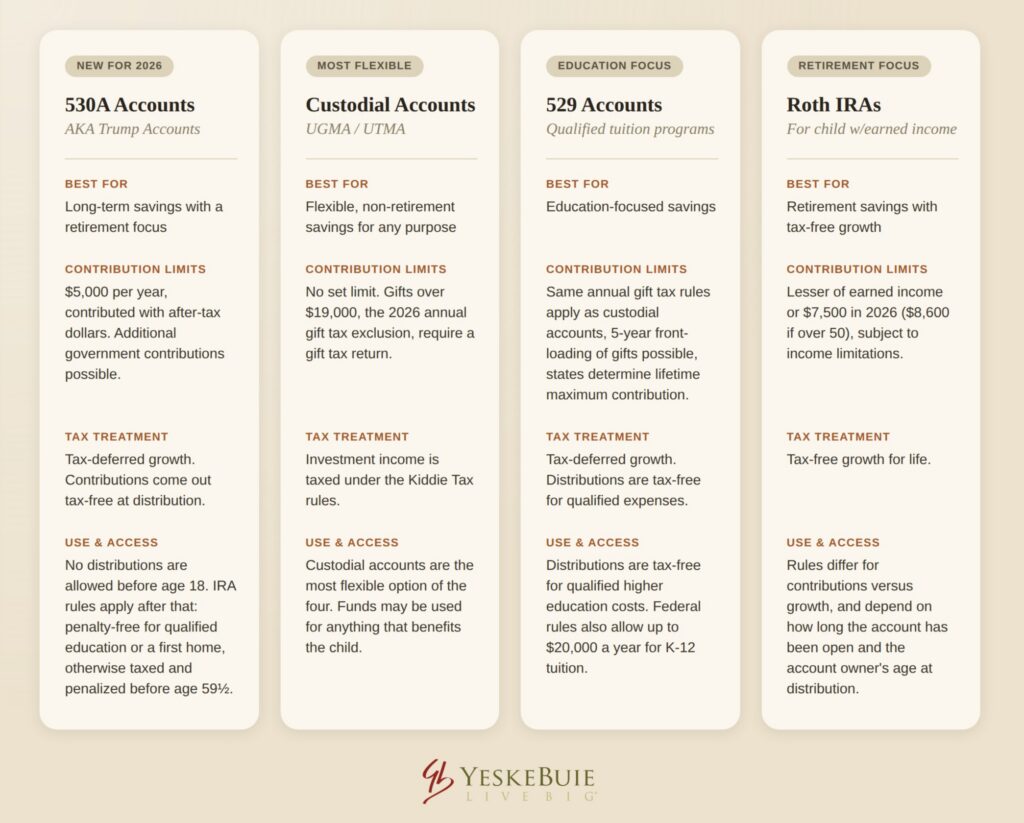
So, now for the real questions: Should you open one of these accounts? A different type of account? Multiple accounts? The answer, as always, is “it depends!” We think there can be a benefit to having multiple types of accounts with various tax treatments and rules. It could make sense to take advantage of the free $1,000 from the U.S. Treasury if your little one(s) is(are) born in the time range (or, if they’re eligible for any alternative seed money for those in ZIP codes with median family income of $150,000 or less). Other potential appealing reasons: your employer is offering contributions or you’re self-employed or you wish to start an investment account that is intended for use much later in life.
If your main goal is education funding, it likely makes more sense to grow funds in a 529 (especially if you live in a state with a tax deduction for contributions). And, if your hope is to build an investment account with fewer restrictions that can be used for anything (with capital gains taxes being the main consideration down the line), a custodial account could be best (though, as always, there are tax considerations for you and your tax situation between now and when the child becomes an adult, and Kiddie Tax rules to think about potentially until they are 26). If your child is old enough to have earned income, a Roth IRA could be the best option (especially if they are willing to contribute some of their earned income and you’re willing to supplement their contributions).
We think we’re good people to think with®, so let’s chat about your situation. We can discuss your goals and hopes for the funds, the amount of cash available now or in ongoing cash flow, desired contributors, and tax considerations for your situation. Give us a call or shoot us an email and we’ll find time to chat!
Disclaimer: This is a high-level summary of specific available accounts. There are many other factors — like contribution and tax details — to consider. Let’s chat before any final decisions are made; we’re good people to think with!®