
A Tale of Two Charts: On NVDA and Diversification


To paraphrase the great urban philosopher Shawn Carter (aka Jay-Z), it was all good a few weeks ago (the song aptly titled “A Week Ago”). Nvidia (NVDA) was up nearly 15% on the year, and 2026 was looking a lot like 2025, 2024, 2023 – the growth had been exponential. Over the past few weeks, we’ve seen NVDA’s share price fall by nearly 25% as the market tries to figure out its prospects given the recent resignation of co-founder and former CEO Jensen Huang.
Let’s just say it at the top: there’s no use in summarizing a story that…
1. Is already eating up enough bandwidth in everyone’s lives; and,
2. Is evolving so rapidly a summary would almost certainly be DOA by the time you found it in your inbox.
So why bother writing a post about a story you’re not going to tell?
Because it’s the story behind the story that we want to highlight – a tale as old as time (no, not that one, Disney fans), and one that is at the foundation of our approach to investments. The story about diversification and the value it provides investors was probably best told by Harry Markowitz. While he didn’t invent diversification, he mathematically quantified its benefits in his 1952 paper “Portfolio Selection”, which was published in the Journal of Finance. Long story short, he was able to demonstrate the total risk of a portfolio of assets doesn’t depend on the volatility of each individual investment, but rather on the way those investments “play together” (to be clear, that quote is attributed to our founder Dave Yeske).
Clients of YeskeBuie know that we don’t invest in any individual company’s stock, but rather in 12,000 companies around the world. Why? Because, as you’ve heard us say, the economy and markets are really just the aggregate representation of the decisions individual people make every day. This is not a hit piece on NVDA, by the way, and we’re not writing this as a critique of Mr. Huang. This is, however, an opportunity to highlight why it pays to avoid having your investments tied to the prospects of one company.
Again, the economy and markets are just a composite of the people in those systems. We believe, on balance, people are inherently resilient and ingenious, and that they want a better tomorrow for themselves and their loved ones; while there are, of course, counterexamples, that is the deep regularity that we believe holds true. And so we design our portfolios to harness that deep regularity, among others. To do that, we need to capture the “aggregate goodness” (Dave again) of those systems by including as many companies (and their people) as we can – from different countries, different sectors, of different sizes and relative expensiveness – to build a robustly diverse basket of investments.
To illustrate the benefit of being diversified away from what, until recently, was the largest company on the planet (having arrived at that status by way of some of the best returns a stock has ever seen; never forget that its average annual return in 2023-24 was over 200%), we thought we’d show you two charts (and no more, though we were tempted, because we really wanted to hit the Dickens reference in the title and work the “story” pun throughout this post – thank you for indulging us):
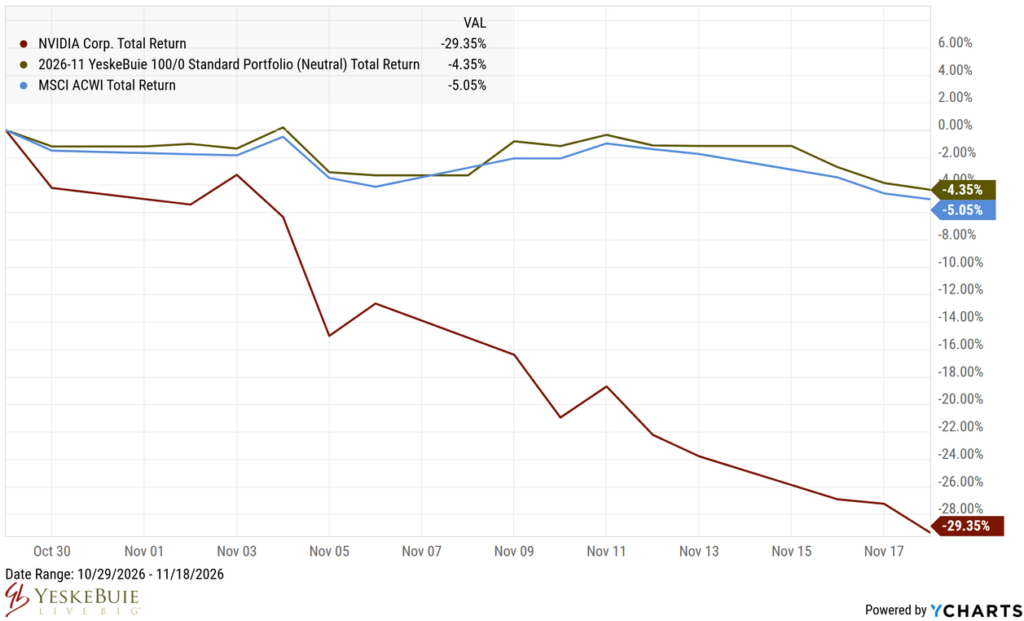
In this first chart, note NVDA’s performance since The New York Times’ report on Mr. Huang on October 29th (through Wednesday of this week). What we want to highlight is the gap between NVDA and the other two lines, our portfolio and our benchmark (the ACWI, or All Country World Index, which tracks stocks all over the world), in recent weeks. That gap is diversification at work.
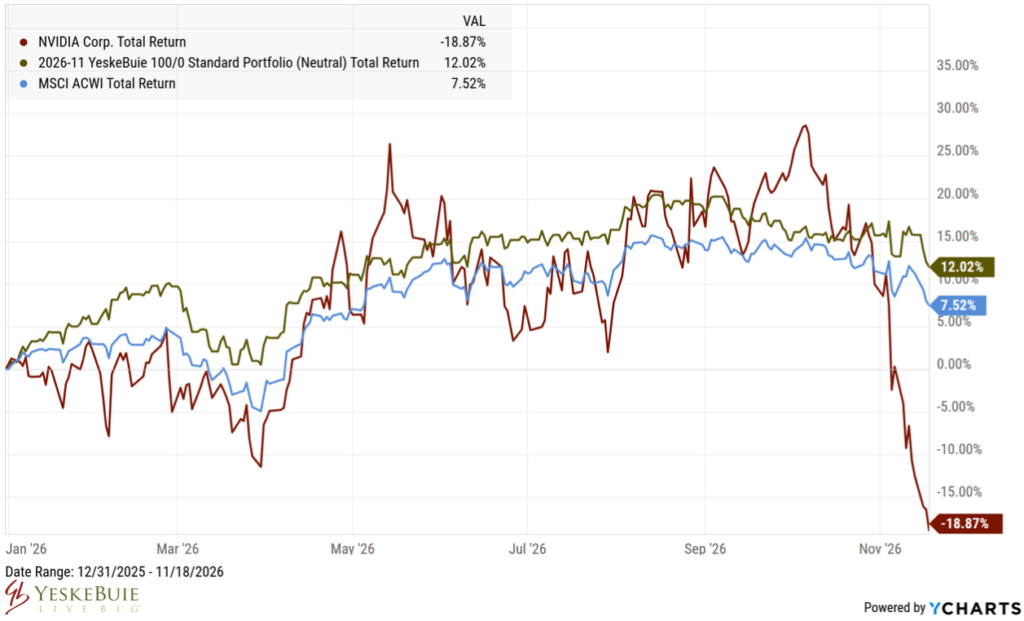
This chart, which tracks the same three players year-to-date, further demonstrates the value of diversification, but in a slightly different way. Note how much more volatile the red line (NVDA) is as compared to that of the index (ACWI, blue) or our portfolio (green). The ranges of their respective returns year-to-date follow:
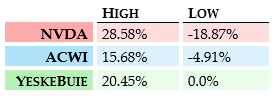
The presence of so many more investments in our portfolio, and the ways in which those investments play together, is what yields the significantly less volatile shape of our line relative to NVDA’s.
NVDA’s story is far from over, and we’re not even going to pretend like we know how it’s going to end. We do, however, know this: YeskeBuie remains committed to a diversified approach. That’s our story, and we’re sticking to it.