
Prepping for Midterms: A Study Guide for Our Upcoming Webinar

As we round the corner and head down the home stretch towards the midterm elections, we thought it might be helpful to review some of the topics that have dominated the headlines over the past year. While we intend to discuss all these items during our webinar on November 10th with a week’s worth of perspective in hand after the votes are cast on November 3rd, we wanted to offer a primer ahead of class, the exam, the show.
If we think back to the number of times we’ve uttered a phrase like “we’ll see what happens at the midterm elections” this year, our team loses count pretty quickly (and we’re numbers people). We’ve seemingly been primed to think that early November will be some sort of revelatory period that will provide insights about how the rest of President Trump’s term will unfold. While we will get explicit answers to the questions of “which party controls the House” and “which party controls the Senate,” it’s difficult to say what else we’ll know for sure beyond that when we wake up on November 4th (or whenever the votes are finally done being counted). And yet we still think it’s helpful to review some of the issues of the day with a focus on how they affect your financial planning objectives. With that, we offer a few items for your consideration in the following segments:
The War in Iran
A war that was supposed to be over in a few weeks has stretched into its ninth month with no end in sight. The Strait of Hormuz will continue to be the focus of the global oil supply chain until the US and Iran can find a path to sustainable peace after multiple failed attempts. Until the war is over, oil prices will be out of whack due to upward pressure from supply limitations and interruptions. And if oil prices are being pushed upward, that will continue to put upward pressure on prices writ large, which means the inflation story isn’t going away until the conflict ends (at the very least – more on inflation below).
Potential Effect of Midterm Elections: It’s difficult to say how the election results may affect policy decisions related to the war, but polls show that it is unpopular on both sides of the aisle. Whomever is sitting in Congress and the Senate could be pressured to address this issue in the early days of their term.
The Federal Reserve and The Economy
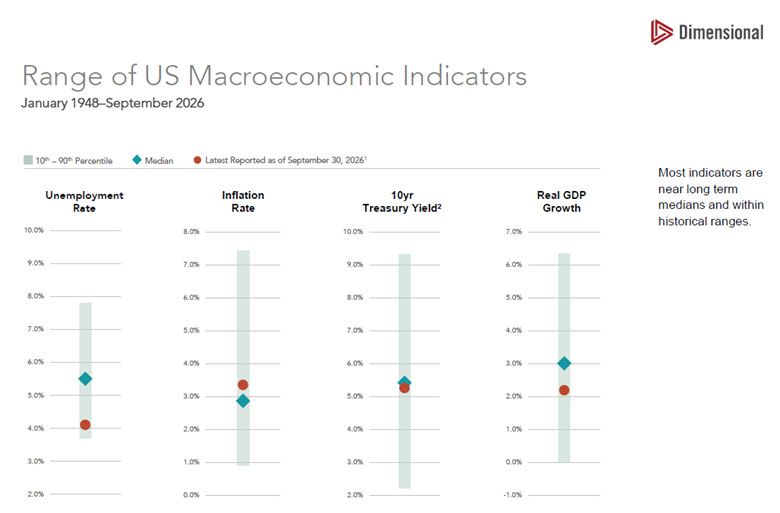
We’ve been tracking the inflation story for what feels like forever (and although it’s only been five years, 2021 feels like eons ago in some respects). In 2023, the headline inflation rate, CPI (Consumer Price Index), had settled down around 3% and hovered there until the effects of several rounds of global tariffs and the war in Iran pushed prices upward. CPI now sits at 3.7%, nearly double the Fed’s goal of 2%.
In more encouraging news, Core CPI (which strips out the effects of Food and Energy prices) is at 2.6%. In other words, when we pull out two of the most volatile segments of the measure (both of which are directly affected by tariffs and oil prices), the inflation story has a much more positive slant. And the overall CPI rate is also hovering near its historical median, so the situation isn’t as dire as it may sound.
On the other side of the Fed’s dual mandate, the labor market continues to be resilient with the unemployment rate clocking in at 4.2%. As long as that measure remains steady (with “full employment” defined by a rate of 4%), the Fed has the latitude to continue to focus on lowering inflation by keeping interest rates “elevated.” Why the air quotes? Because if we look back historically, we note that the current Federal Funds rate (ranging between 3.75% and 4%) sits below the long-run average of ~4.6%. On top of that, many of the major economic indicators we track when assessing economic health are near their respective long-term medians:
Potential Effect of Midterm Elections: Hopefully none, as the Fed is meant to act independently of our political system. By the time we go live for our webinar on November 10th, the Fed will have met for the penultimate time in 2026 (October 27th and 28th) and we’ll know whether or not they’ve raised rates. While the next inflation readings will occur after that meeting (CPI: November 10th; PCE [Personal Consumption Expenditures, the Fed’s preferred inflation measure]: October 29th), that data will be available for the Fed’s final meeting of the year (December 8th and 9th).
AI: Anthropic and OpenAI IPOs, the Data Center Buildout, and Security Policies
As you’ve certainly heard, AI is changing everything about everything. We’ll focus our comments here on three stories, one which we don’t think the midterms have any bearing on, one which almost assuredly will be affected by the outcome of the elections, and a final one that we see as an issue that will require global collaboration irrespective of one’s political leanings:
- Unaffected: Anthropic and OpenAI Initial Public Offerings (IPOs)
These two massive companies are almost assuredly going public. By the time we meet for our webinar, Anthropic may be available for purchase; OpenAI is likely not far behind and may hit the exchanges before the end of the year or in early 2027. Like SpaceX before them, we won’t be recommending that our Clients participate in purchasing the shares of either of these companies directly (or any other individual company’s stock – as our readers know, it’s diversification over everything in the YeskeBuie portfolio). And we share this note because these IPOs will chew up headlines. - Affected: Data Center Buildout
If you own a TV and have had it turned on during primetime over the past few weeks, we’d be willing to bet a significant sum that you’ve seen a political ad that references data centers and their ongoing buildout (on land, in space, or elsewhere). This issue has become fiery and fraught, and likely isn’t going anywhere regardless of the way the midterms go. If the Democratic Party ends up winning a number of the available seats in Congress and the Senate, look for more restrictive policies on future data center construction (with the opposite expectation if the Republican Party wins). - Bipartisan: AI Security Policies
In our view, Derek Thompson (formerly of The Atlantic) offers one of the clearest descriptions of the current AI ‘arms race.’ In his pieces dated September 10th and September 24th, 2026 (“AI Safety is Having a Moment” and “How China Thinks About AI”, respectively), Thompson, responding to former Anthropic pretraining researcher Jacob Coxon’s claims about a lack of safety protocols in ongoing AI development, describes the present dynamic as a double prisoner’s dilemma. Within the US:
-
- Anthropic claims to take a safer approach than OpenAI, so it can’t slow down its development before OpenAI builds machine intelligence that escapes human control;
- OpenAI feels the same way about Anthropic, so it can’t slow down (all the while both companies are publicly calling for the industry to slow down);
And the same is true globally, just substitute America and China for the company names:
-
- The US claims to take a safer approach than China, so it can’t slow down its development before China builds machine intelligence that escapes human control;
- China feels the same way about the US, so it can’t slow down (however in this instance the nations are positioning themselves against each other in a competitive manner rather than a cooperative engagement);
Potential Effect of Midterm Elections: See above for the first two items; on the third (security policies), we’ll just state plainly that if this technology is half as powerful as it is purported to be, then the frontier labs and nations of the world must come to an agreement about security protocols as we did with nuclear weapons decades ago. It’s that simple. We’re pretty confident that national and international AI security policies could be affected by who sits in Congress and the Senate for the next two years.
The Stock Market and The Bond Market: Performance and Outlook
While the stock market is always in the news, the bond market has been outshining its compatriot as of late and bringing all the drama. Why? We invite you to review this chart showing how the yield curve has evolved over the past year:
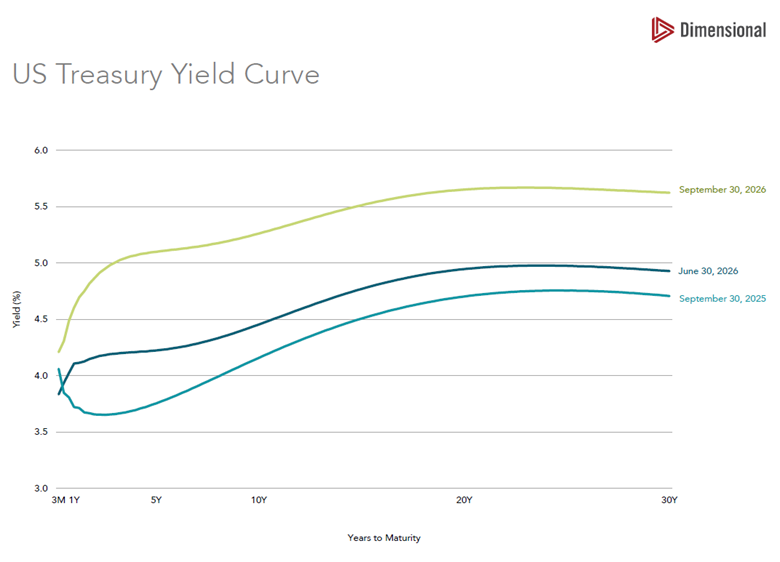
A year ago, the yield curve was “inverted” (light blue line). While in “normal” circumstances, a bondholder can expect higher yields (or rates of interest earned by holding bonds) for bonds with longer maturities, which makes sense: the longer you forego the right to spend your money as a lender when purchasing a bond, the more compensation you require in the form of interest payments. An inverted yield curve doesn’t follow that logic, and, instead, yields for shorter-term bonds provide a higher rate of return than longer-term bonds. Furthermore, with rates rising and inflation expectations pointing to higher prices in the future, the bond market’s expectation is that rates will continue to rise.
That’s what’s pushed 10-year treasuries, one of the key indicators that investors watch when assessing investment decisions, up to their highest levels in 20 years (over 5%). And when that happens, it changes the calculus for investors and puts downward pressure on stocks because, in part, bonds yielding 5% become more attractive to relatively conservative investors (additionally, higher costs of capital in the form of higher interest rates also put downward pressure on stock prices given that a company’s stock is just a representation of the expectations of its future performance, and higher costs impede profits and can lead to sagging stock prices).
And yet, the following statements are true:
- Through the end of last week (October 16th), the YeskeBuie portfolio of stocks has returned 14.78% YTD (net of fees)*, whereas
- The MSCI ACWI (All Country World Index) has returned 12.51%, and
- The S&P 500 has returned 12.88% over the same period.
- The bonds in our spending Clients’ accounts (which comprise their Stable Reserve, a reservoir of 6–7 years of their spending needs) are all in the black on the year with current projected yields of 4.88% (DFA’s One-Year Fixed Income Portfolio) and 5.27% (DFA’s Five-Year Global Fixed Income Portfolio).
Potential Effect of Midterm Elections: While in the short run there may be some noise, in the long run, we already know the market doesn’t care who’s President, and we believe the same to be true about those in the House and the Senate.
So where will things stand in a few weeks when we reconvene in real time? Literally nobody knows. So do your homework, study up, and come to class prepared for a lively discussion when we get together after the votes are counted. And if you need anything in the meantime, YeskeBuie office hours are 9am to 5pm in both ET and PT, no appointment or hall pass required.