
The Anatomy of Your Portfolio’s Returns

If you’ve been a Client long enough to receive a few of our digests or attend a webinar or two, you’ve likely read or heard versions of the following phrases as descriptions of the YeskeBuie portfolio of stocks:
- “12,000 companies scattered around the world”
- “Globally neutral, but tilted in favor of small and value companies”
- “A broadly diversified basket of investments designed to harness growth from wherever it emerges”
We’re gratified to be able to say that this portfolio has served our Clients well for more than 30 years*, and we want our Clients to have a real sense of what’s inside it and why it’s built the way it is. This post digs a bit deeper, addressing three questions the phrases above naturally raise: Why is the portfolio so broadly diversified? What does “globally neutral” mean in practice? And how does the tilting toward small and value companies work?
Why is the YeskeBuie portfolio so broadly diversified?
To begin, we constructed the following table to provide a summary of the mutual funds that comprise the equity (read: stocks) side of our portfolio. While we appreciate that virtually all our Clients carry bonds in their portfolio as well, this piece will focus on the stocks and how we think about the building blocks that form the core of our standard equity portfolio. And, while we offer different versions of this portfolio to our Clients in various circumstances (i.e. our small model portfolio for accounts with balances below $100,000, or our portfolios with a sustainability focus), this model is the template upon which all of our other models are based (and is how our own personal accounts are invested, too).
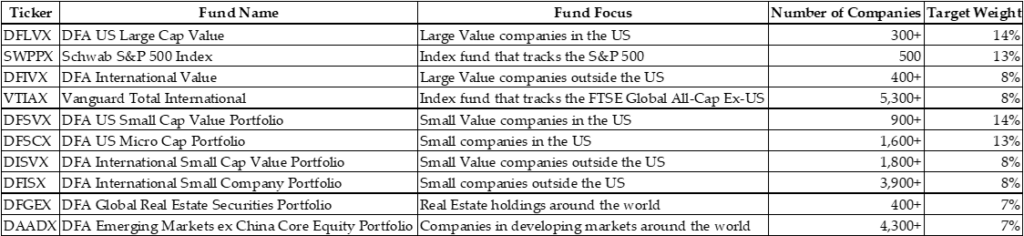
If you add up the number of companies, you’ll note that the total approaches 20,000, well ahead of the 12,000 figure previously quoted. That’s simply due to the fact that some companies are represented in more than one fund. For example, many of the companies in DFA’s US Large Cap Value fund are also in the S&P 500. In intentionally including them twice, we’re able to both track the S&P 500 and tilt the portfolio in favor of value stocks (more on that in a bit).
You’ll note there are ten mutual funds in total, with the first four on the list tracking the performance of large companies in the US and abroad. The next four track domestic and foreign small companies, and the final two funds scoop up exposure to global real estate investments and companies in developing markets around the world.
But why so many mutual funds? And why emphasize the presence of more than 12,000 companies across these baskets of investments? Because diversification is one of the best ways to reduce the risk of a portfolio. In spreading our Clients’ investments across so many companies in dozens of countries around the world, the risk of the portfolio is curbed because of the way the different types of investments interact with each other. To put it differently, they don’t all move in exactly the same direction at exactly the same time, and the combining of non-perfectly correlated investments reduces the volatility.
So, the next time your friend or family member claims to be broadly diversified because they own the 500 stocks in the S&P, you can smile and let them know what a truly diversified portfolio can look like.
What does “globally neutral” mean in practice?
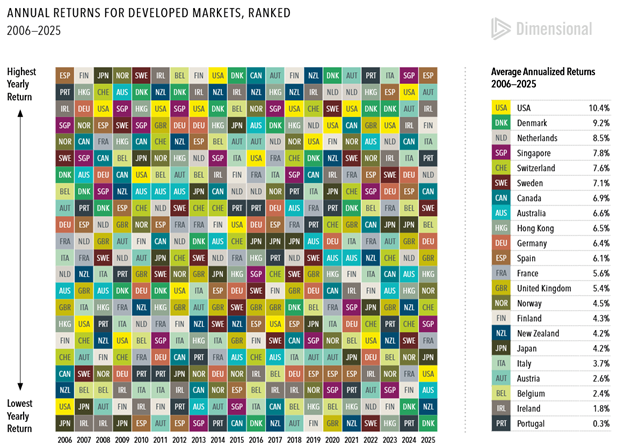
In our minds, the term “geographically neutral” means that we don’t tilt the portfolio in favor of any given country. In other words, we aim for the proportion of each country’s publicly traded stocks relative to that of the global stock market to take up a commensurate amount of space in our portfolio. The rationale that justifies that decision is the inability to predict which companies in which countries will outperform the rest. If we look back at historical returns, performance leadership between countries changes on a completely random basis. So, absent the ability to reliably and consistently predict the future, we think weighting each country’s presence in our portfolio based on the space it takes up in the global market is the most appropriate way to structure our Clients’ investments.
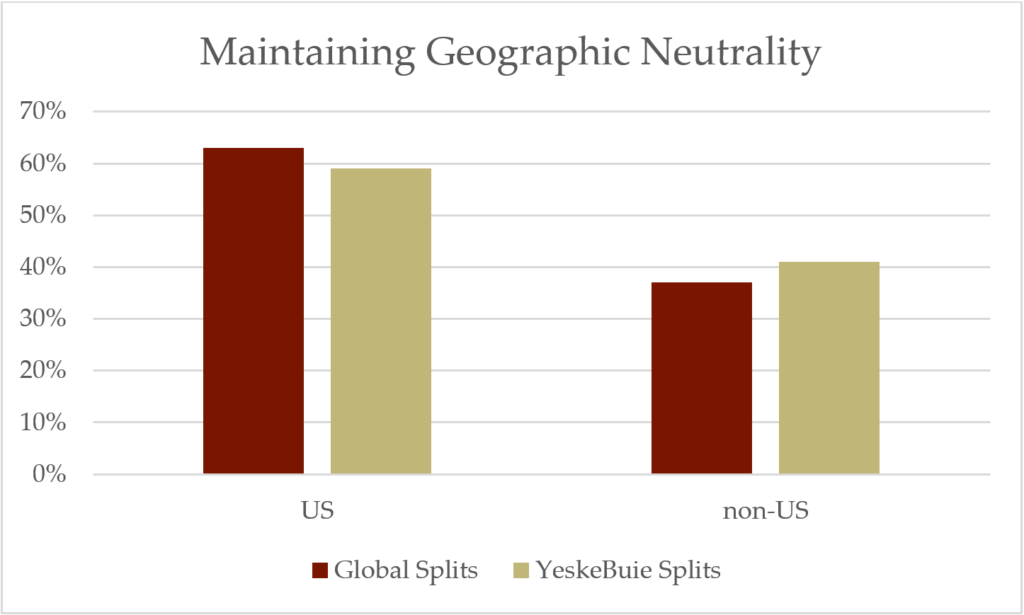
As you saw in the table we built at the top of this piece, we achieve what we describe as geographic neutrality with splits of 59% US and 41% non-US stocks:
- To get to the US’s portion of 59%, take the weights of DFLVX, SWPPX, DFSVX, and DFSCX and add them together (54%), then add in another 5% from DFGEX.
- The Global Real Estate fund includes a bit of both US and international real estate exposure, with a tilt in favor of US properties.
- To get the non-US total, add the weights of DFIVX, VTIAX, DISVX, DFISX, and DAADX to get 39%, then sprinkle in the remaining 2% from DFGEX.
While the global stock market is split 63% US/37% non-US, we have intentionally maintained our positioning of 59% US/41% non-US as a recognition of just how expensively US companies are currently priced (specifically large, non-value companies). To say it differently: we think large companies in the US (especially those in the technology sector) are currently taking up too much space relative to their less-expensively-priced counterparts and are therefore intentionally not mirroring that skewness in our portfolio.
We evaluate these splits every quarter when Dimensional releases its Global Market Breakdown and provides measures of a number of key aspects of the market, and we make decisions about adjusting these splits within the context of what we’re seeing in the global stock market.
How does the tilt toward small and value companies work?
In the table, we also included the target weight for each fund to give you a sense of how we tilt toward small companies and value companies. Any fund name with “value” in its title (there are four) has a value focus, and the same is true for any fund name with “small” in its title (likewise, there are four if you include the US Micro Cap portfolio). For reference, value companies represent roughly 35% of the global market (44% of our portfolio), and small companies represent 11% of the global market (43% of our portfolio).
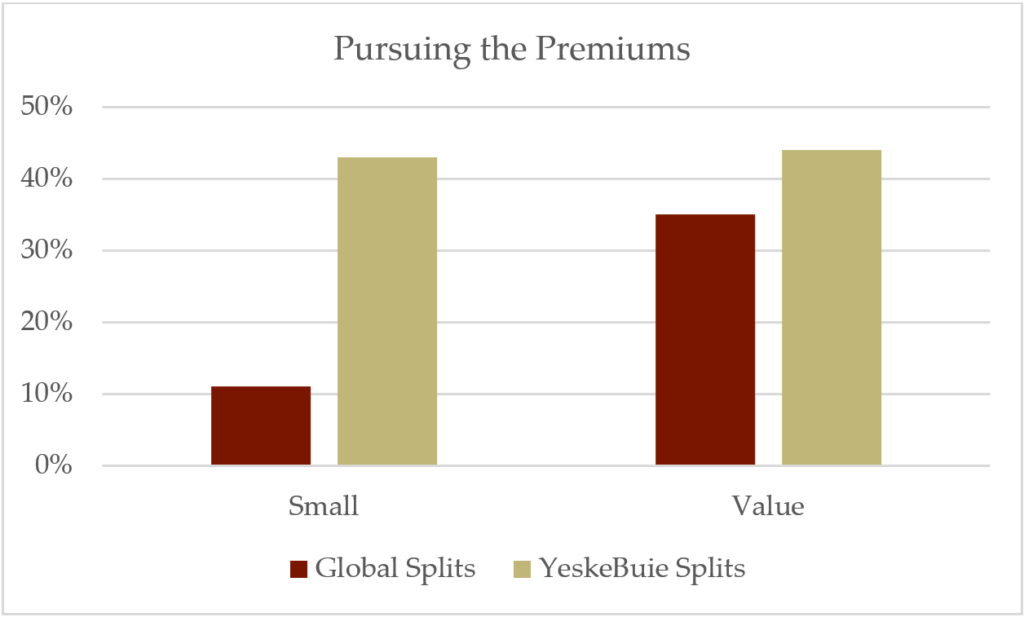
Just as we are intentional in the manner we allocate our Clients’ investments geographically, we are deliberate in the design of our portfolio in the way we create these tilts towards small companies and value companies. Historical performance shows us that there’s a persistent, pervasive premium (i.e. additional expected return) that comes with investing in these types of companies, and we expect that phenomenon to continue because risk and return are related.
Value companies are companies whose stock price has been pushed down recently and are, therefore, priced for higher returns going forward. The reduced stock price represents investors’ assessment of the company’s risk – if their collective assumption is that the uncertainty around a given company’s performance has increased, the only way to compensate them for that additional risk to lower today’s price. This dynamic creates value in the present as shares can now be bought at a relatively lower price, and we seek to capitalize on that opportunity by “buying low” with the intent to “sell high” in the future.
Similarly, we also tilt the portfolio in favor of small company stocks because of the premium associated with investing in these companies. The risk-reward profile of a small company as compared to a larger one suggests that there’s an additional return to be gained by investing in them, as they’re relatively riskier. Again, to mitigate that risk, we invest in thousands of these companies at once by way of the mutual funds we employ, allowing us to capitalize on the deep regularities in how these companies perform without being overly concentrated and a prisoner to a given company’s performance. When you put it all together, you get a portfolio that can be illustrated using the following two visuals:
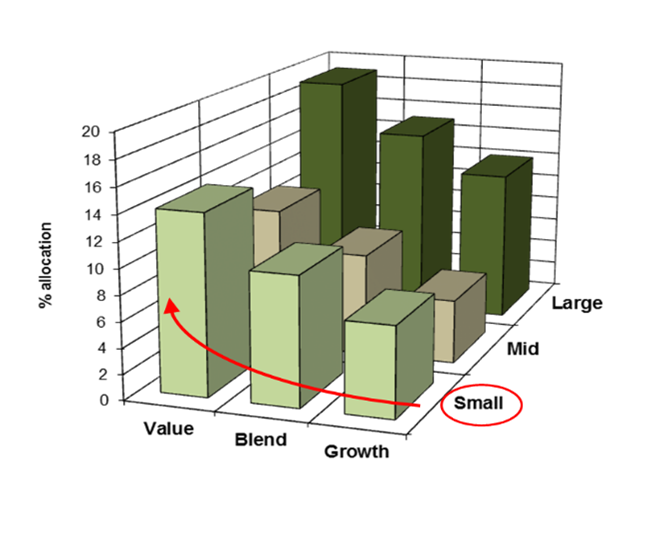
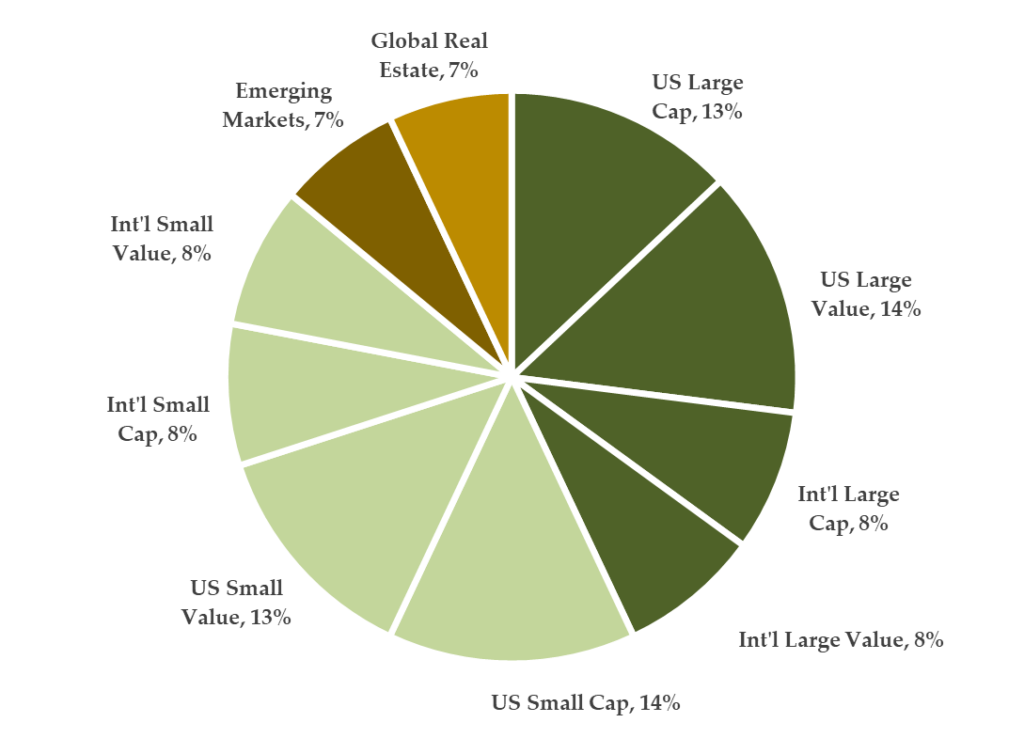
As you’ve heard us say, we diversify the portfolio in the way that we do because we believe it’s one of the best ways to mitigate risk in an evidence-based manner*; that’s why you have 12,000 stocks of all sizes and valuations working for you from every corner of the globe. And we tilt toward small and value stocks because the evidence suggests there’s a premium to be gained by positioning your portfolio to capture those companies’ performance. That’s why we say this portfolio is designed to harness the global stock market and capture growth from wherever it emerges, and that approach has worked for decades.
We hope you found this post to be a helpful look inside the portfolio, and we’d love to hear from you either way. If it sparked further questions about the portfolio’s design, send us an email or give us a call so we can continue the conversation.