
Student Loan and College Planning Mini-Series: Part One

Since the COVID-19 pandemic threw the world into turmoil, student loan borrowers have grappled with uncertainty regarding loan forgiveness, payment requirements, and available repayment plans. With last year’s passage of the One Big Beautiful Bill Act (OBBBA), borrowers finally received some needed clarity on the student loan landscape.
However, with that clarity comes a more restrictive framework which significantly curtails student loan borrowing options and increases repayment obligations. And despite the clear decisions that Congress has made through the OBBBA, there continues to be debate in the political sphere around the role of student loans in American education.
Given the significance of the changes and the complexity of the impacts on borrowers, we’re structuring this article in two parts:
- Part One: Loans, Limits, and Legislation: What OBBBA Changed
- Part Two: Strategy, Support, and the Student Loan System Going Forward
This edition covers Part One, breaking down exactly what the OBBBA changed, new borrowing caps, the new repayment plan, and what’s being phased out. Part Two will follow soon with practical guidance for students, parents, and current borrowers navigating this new landscape.
Part One – Loans, Limits, and Legislation: What OBBBA Changed
So, what has changed? In short, the OBBBA instituted a new framework for student loan borrowing limits and loan repayment plans. Borrowing limits for federal unsubsidized undergraduate student loans remain unchanged, with a loan cap of $27,000 over four years. And Parent PLUS loans have been capped at $20,000 per year per child, with a lifetime cap of $65,000 per student.
This means that the total federal borrowing available to each undergraduate student is $92,000. “Given that some schools charge close to that amount for just a single year of attendance, families without significant savings will need to either take out significant private debt with much less flexibility or rethink their college choices altogether,” said Ryan Frailich, CSLP®, a Certified Student Loan Planner, and Ethan Miller, who has studied student loan debt since 2015, in their article posted to Kitces.com.
Borrowing options for graduate students are being restricted as well: graduate PLUS loans will be eliminated entirely. The Direct Unsubsidized Loan program is now the sole source of federal borrowing for graduate students, with a pre-existing annual cap of $20,500 ($50,000 for professional degree programs).
Considering all of these changes together, there is now a combined lifetime borrowing cap of $257,500 across all federal student loan programs (excluding Parent PLUS loans). No such cap existed under previous law.
But student loan borrowing limits weren’t the only new rules introduced by the OBBBA. There were three major changes to the repayment plans offered to federal student loan borrowers. First, and perhaps most significantly, a new income-driven repayment (IDR) plan known as the Repayment Assistance Plan (RAP) has been introduced beginning in 2026. Under the RAP, monthly loan payments are a percentage of Adjusted Gross Income (AGI), scaling from 1% to 10% depending on the borrower’s level of income. Comparing the new RAP with prior repayment plans, Frailich and Miller state, “Although required repayment amounts under RAP will generally be higher than they would have been under the now-paused SAVE plan, they will often be lower than payments required under IBR.” Borrowers on RAP will be eligible for loan forgiveness after 30 years of payments, though the forgiven balance will be considered taxable income.
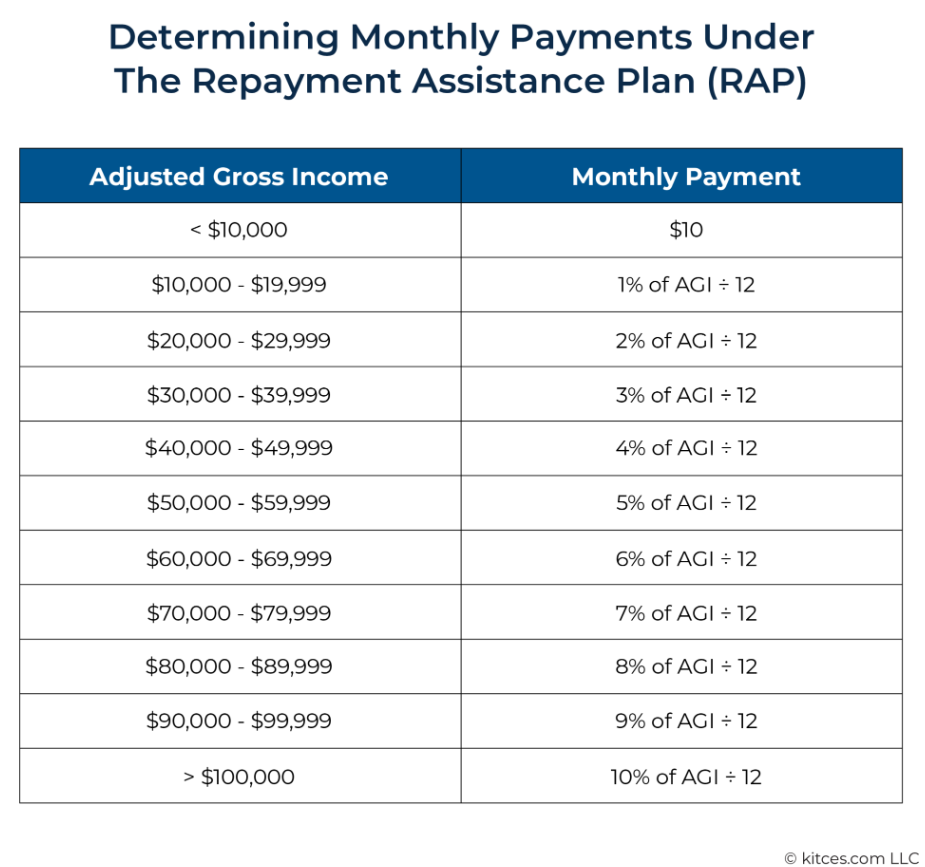
The new Repayment Assistance Plan does come with a few key benefits. First, unlike under prior IDR plans, RAP fully subsidizes any unpaid interest after each month’s payment, which means that unpaid interest is not added to the loan balance at any point. Additionally, RAP guarantees that the loan balances will drop by a minimum of $50 each month, even if the borrower’s required payment does not fully cover the monthly interest owed.
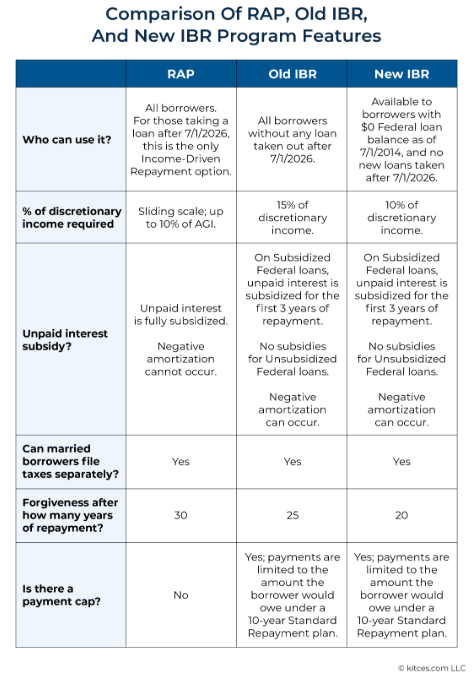
The Standard repayment plan has also been reworked. The old plan was a fixed 10-year repayment schedule, which made payments onerous for many borrowers. The new repayment terms on the Standard plan range from 10-25 years, depending on the amount owed. However, it is important to note that borrowers on the longer end of the repayment term (closer to 25 years) will not be eligible for Public Service Loan Forgiveness (PSLF) unless they proactively switch to an eligible IDR plan. By July 1st, 2028, the ICR, PAYE, and SAVE (formerly REPAYE) plans will be eliminated for all borrowers. Going forward, borrowers will have access to only two IDR repayment options: IBR and RAP. And for federal student loans taken out after July 1st, 2026, the only option for an IDR plan is the RAP. Finally, new Parent PLUS loan borrowers (anyone who has or will borrow after 7/1/2026) can only be enrolled in the standard repayment plan.
The breadth of student loan changes under the OBBBA are significant, so if nothing else, we encourage you to review the graphics and summary tables more closely here to gain a better understanding of the differences between the new RAP plan and the IDR plans that existed under prior laws. And, of course, reach out to a member of your Financial Planning Team if you have any questions about your specific situation.
Understanding what changed is only half the equation. Coming soon, we’ll turn to what borrowers should actually do next, because there’s never been a more important time for students and parents to plan proactively for college.
Sources
- Kitces, “OBBBA Breakout Guide: Student Loan Changes For Financial Advisors To Know – New Borrowing Limits, Parent PLUS, RAP, And Legacy IDR Plans,” Aug. 20, 2025.
- College Inside Track, “4 Strategies for a Smarter College Search,” Dec. 12, 2024.