
Student Loan and College Planning Mini-Series

Last Updated: October 5, 2026

Since the COVID-19 pandemic threw the world into turmoil, student loan borrowers have grappled with uncertainty regarding loan forgiveness, payment requirements, and available repayment plans. With last year’s passage of the One Big Beautiful Bill Act (OBBBA), borrowers finally received some needed clarity on the student loan landscape.
However, with that clarity comes a more restrictive framework which significantly curtails student loan borrowing options and increases repayment obligations. And despite the clear decisions that Congress has made through the OBBBA, there continues to be debate in the political sphere around the role of student loans in American education.
Given the significance of the changes and the complexity of the impacts on borrowers, we’re structuring this article in two parts:
First, we’ll break down the new rules, from borrowing caps to the overhaul of repayment plans, then turn to how borrowers can navigate them.
Part One: Loans, Limits, and Legislation: What OBBBA Changed
So, what has changed? In short, the OBBBA instituted a new framework for student loan borrowing limits and loan repayment plans. Borrowing limits for federal unsubsidized undergraduate student loans remain unchanged, with a loan cap of $27,000 over four years. And Parent PLUS loans have been capped at $20,000 per year per child, with a lifetime cap of $65,000 per student.
This means that the total federal borrowing available to each undergraduate student is $92,000. “Given that some schools charge close to that amount for just a single year of attendance, families without significant savings will need to either take out significant private debt with much less flexibility or rethink their college choices altogether,” said Ryan Frailich, CSLP®, a Certified Student Loan Planner, and Ethan Miller, who has studied student loan debt since 2015, in their article posted to Kitces.com.
Borrowing options for graduate students are being restricted as well: graduate PLUS loans will be eliminated entirely. The Direct Unsubsidized Loan program is now the sole source of federal borrowing for graduate students, with a pre-existing annual cap of $20,500 ($50,000 for professional degree programs).
Considering all of these changes together, there is now a combined lifetime borrowing cap of $257,500 across all federal student loan programs (excluding Parent PLUS loans). No such cap existed under previous law.
But student loan borrowing limits weren’t the only new rules introduced by the OBBBA. There were three major changes to the repayment plans offered to federal student loan borrowers. First, and perhaps most significantly, a new income-driven repayment (IDR) plan known as the Repayment Assistance Plan (RAP) has been introduced beginning in 2026. Under the RAP, monthly loan payments are a percentage of Adjusted Gross Income (AGI), scaling from 1% to 10% depending on the borrower’s level of income. Comparing the new RAP with prior repayment plans, Frailich and Miller state, “Although required repayment amounts under RAP will generally be higher than they would have been under the now-paused SAVE plan, they will often be lower than payments required under IBR.” Borrowers on RAP will be eligible for loan forgiveness after 30 years of payments, though the forgiven balance will be considered taxable income.
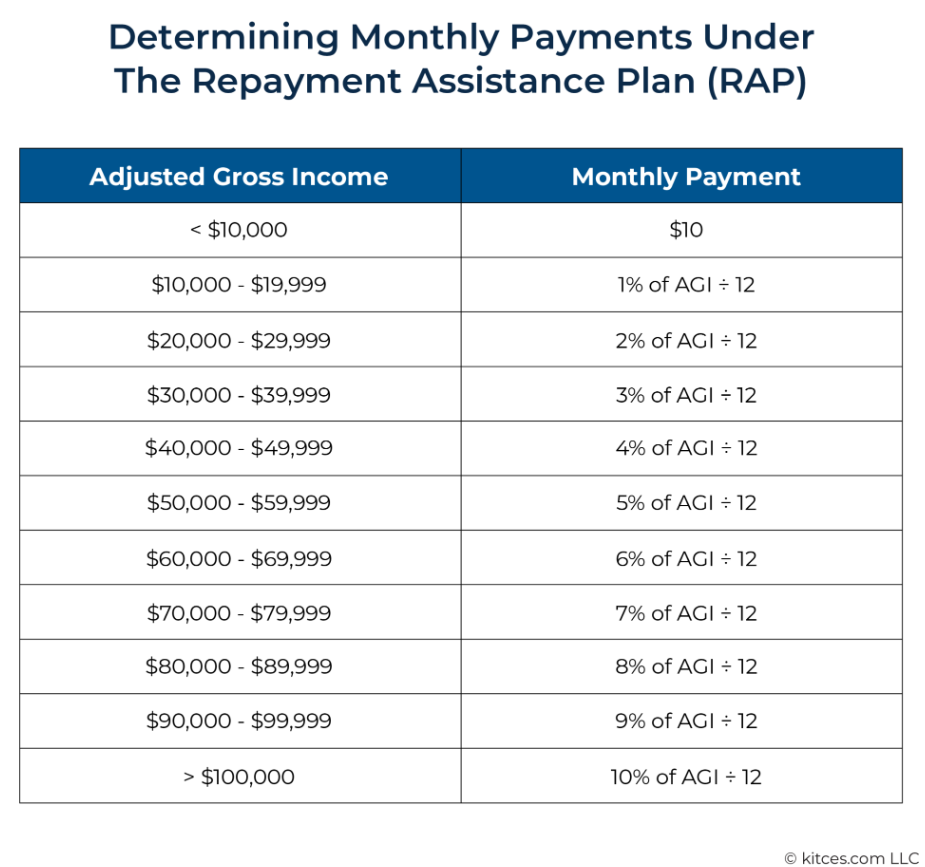
The new Repayment Assistance Plan does come with a few key benefits. First, unlike under prior IDR plans, RAP fully subsidizes any unpaid interest after each month’s payment, which means that unpaid interest is not added to the loan balance at any point. Additionally, RAP guarantees that the loan balances will drop by a minimum of $50 each month, even if the borrower’s required payment does not fully cover the monthly interest owed.
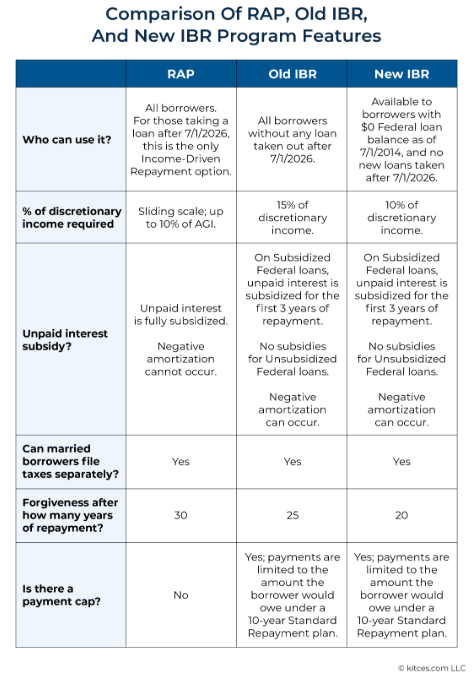
The Standard repayment plan has also been reworked. The old plan was a fixed 10-year repayment schedule, which made payments onerous for many borrowers. The new repayment terms on the Standard plan range from 10-25 years, depending on the amount owed. However, it is important to note that borrowers on the longer end of the repayment term (closer to 25 years) will not be eligible for Public Service Loan Forgiveness (PSLF) unless they proactively switch to an eligible IDR plan. By July 1st, 2028, the ICR, PAYE, and SAVE (formerly REPAYE) plans will be eliminated for all borrowers. Going forward, borrowers will have access to only two IDR repayment options: IBR and RAP. And for federal student loans taken out after July 1st, 2026, the only option for an IDR plan is the RAP. Finally, new Parent PLUS loan borrowers (anyone who has or will borrow after 7/1/2026) can only be enrolled in the standard repayment plan.
The breadth of student loan changes under the OBBBA is significant, so if nothing else, we encourage you to review the graphics and summary tables more closely here to gain a better understanding of the differences between the new RAP plan and the IDR plans that existed under prior laws. And, of course, reach out to a member of your Financial Planning Team if you have any questions about your specific situation.
Understanding what changed is only half the equation. Let’s turn to the other half: what students, parents, and borrowers can actually do about it.
Part Two: Strategy, Support, and the Student Loan System Going Forward
Behind buying a home, college is the second-biggest expense most families will face in their lives. That kind of investment makes it worth taking the time to find a school that truly fits you. This means finding the right…
-
- Academic fit: Consider a school offering your preferred major, the appropriate level of academic rigor, and compelling courses.
- Social fit: Do the campus culture, location, and friends align with your hobbies and interests? Do you want to live in this place for four years?
- Financial fit: There is no one path that makes college less expensive – every student’s experience is going to be unique to them.

When approaching the financial aid conversation, you should fill out the Free Application for Federal Student Aid (FAFSA) even if you don’t expect to be a recipient of financial aid. Some merit-based scholarships offered by universities won’t consider students unless they have submitted a completed FAFSA. On that note, colleges themselves are the single largest source of scholarships – not the internet or private parties! So do what you can to communicate and negotiate with your chosen school to advocate for the best deal you can get.
When searching for a school, look for one that offers merit aid and where you as a student can bring something compelling to campus, such as extracurricular talents, unique demographic characteristics, or grades and test scores that fall into the top 25-33% of the student body. Know that it is more likely for a student to have a positive outcome by going to a school where they thrive than by struggling at a brand-name school just for the name recognition alone.
What Should Borrowers Do After College?
For those of you who have finished college or have children who are in the midst of navigating their student loan repayment, consider this guidance from the Brookings Institution and Frailich and Miller at Kitces.com. First and foremost, borrowers should make sure that they have their username and password for studentaid.gov. The resources found on this government website will help borrowers understand who their student loan servicer is if they don’t already know and will provide contact information for someone to reach out to for help.
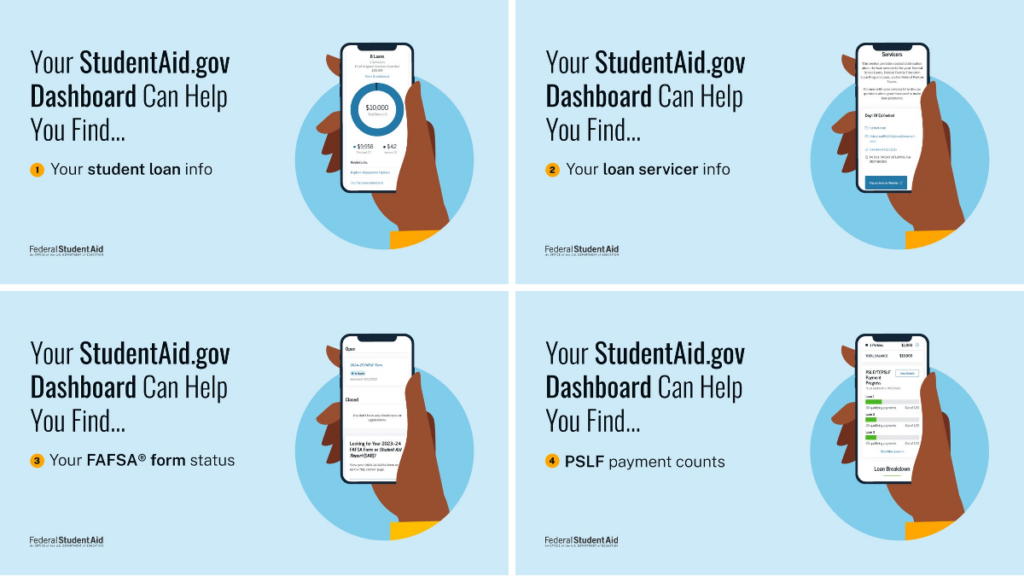
The student aid website also features several self-service tools, such as a list of the available repayment plan options and a loan simulator which helps borrowers figure out which repayment plan works best for their specific set of loans (especially if they are interested in PSLF). And it is recommended that borrowers contact their student loan servicer if studentaid.gov can’t answer their questions.
As for practical adjustments, the general consensus is that borrowers with existing loans should switch to an IDR plan (either IBR or RAP) today to continue earning credit toward loan forgiveness. When deciding on a payment plan, borrowers should consider the tradeoffs between making low monthly payments and the total payoff cost (principal + interest) over time. Can you afford to pay your student loans for 30 years before receiving some form of taxable forgiveness, or should you make higher monthly payments with the goal of paying off your loan entirely?
Lastly, student loan servicers continue to face staffing issues, occasionally leading to errors and frequently leading to long wait times on the phone. To combat these issues, borrowers should keep clear records of their own payment statuses, and if a borrower requests a change from one repayment to another, they should follow up with their student loan servicer proactively to review that the change was processed correctly.
Ongoing Policy Challenges
Just because the above student loan rules have become law doesn’t mean that they can’t be changed in the future. Indeed, there is a constant debate in the political sphere around student loans revolving around two primary schools of thought. On the one hand, some believe that student loans should be harder to get so that people in low-paying professions (like teachers or social workers) don’t end up with more loans than they can afford to pay back on their incomes. According to these groups, the risk of making student loans widely available with little to no limitations is that educational institutions are therefore disincentivized to keep prices down. (In theory, if borrowers can take out an unlimited amount of debt, then universities can charge an unlimited amount of money for students to attend.) This is why Grad PLUS loans and undergraduate federal subsidized loans have borrowing limits that haven’t been raised in years.
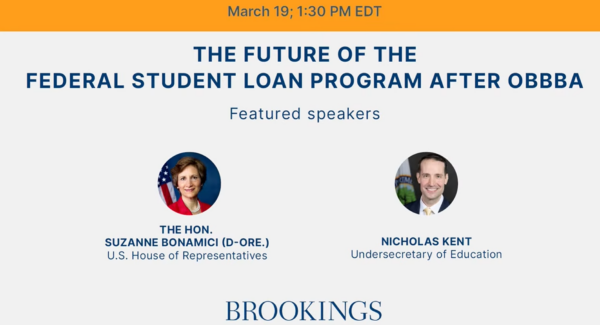
As one example, Nicholas Kent, Undersecretary of the Department of Education, stated in the Brookings webinar that some educational institutions (such as one unnamed law school) have already begun to reduce their tuition rates because of the OBBBA, which capped professional student loan amounts at $50,000 per year (or $200,000 total). One particular institution, which Kent cited had been raising its tuition by a few thousand dollars each year, reduced the cost back to $50,000 to conform with the student loan cap.
On the other hand, others think that there should be more programs that make loan repayment more affordable so that students can take out as much student loan debt as they need to get a quality education. Students can then pay back their loans (or have them forgiven) using these programs that allow them to take roles that benefit society but may not be as lucrative. This is where programs like PSLF come from. Representative Suzanne Bonamici (D-OR) said on the Brookings webinar that her goal is to have states invest an appropriate amount into education as well. She argues that states have a role to play in keeping college more affordable by offsetting the costs that schools face, allowing them to keep costs down for students. This perspective lends itself to a more holistic approach to education policymaking, shifting the focus away from student loans as the sole culprit for the exorbitant cost of college.
Regardless of the approach, leaders have a responsibility to emphasize stability in the system. It is easy for politicians and the media to chase headlines about issues with the Department of Education, but that then leads to borrowers thinking, “I don’t even know if the Department of Education still exists! How can I be expected to pay off my student loans?” Policymakers on both sides of the aisle expressed on the Brookings webinar that they share a desire to connect their constituents with resources and information that will help make it easier for them to pay back their student loans.
What Does It All Mean for Me?
After years of uncertainty, Congress has injected some stability into the student loan system, but with this injection comes confusion and an increased burden on borrowers. Now more than ever, it is important for students and parents to plan proactively for college. At YeskeBuie we are working diligently to expand our knowledge of the student loan and education policy landscape so that we can better serve you, our Clients. If you ever have any questions about charting your own course through your educational journey, please don’t hesitate to contact us. We’re good people to think with®!
Sources
- FAFSA (@FAFSA), “First few words of the post…,” X, Sept. 16, 2024.
- Kitces, “OBBBA Breakout Guide: Student Loan Changes For Financial Advisors To Know – New Borrowing Limits, Parent PLUS, RAP, And Legacy IDR Plans,” Aug. 20, 2025.
- College Inside Track, “4 Strategies for a Smarter College Search,” Dec. 12, 2024.