
The Investment Answer: A Book Club Reflection
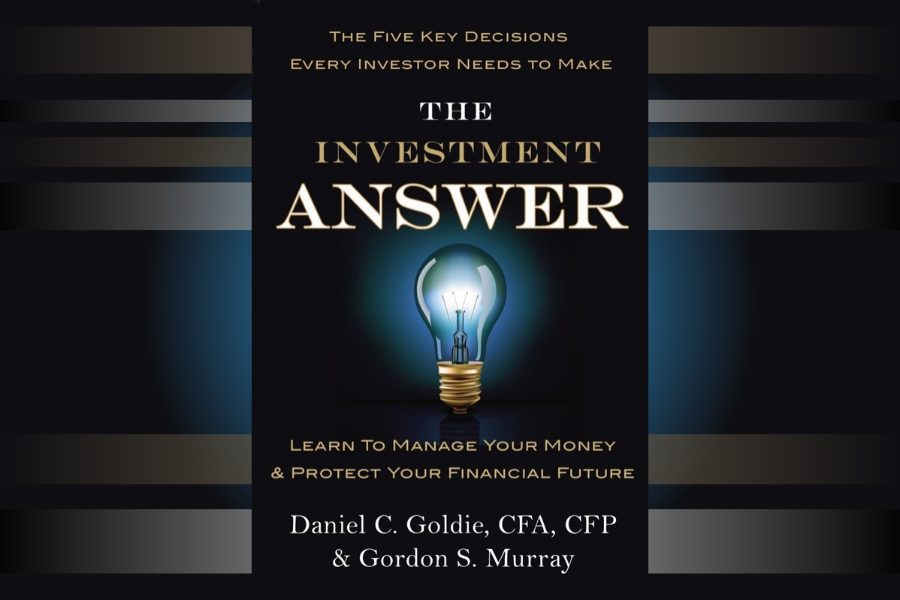
We have sent a copy of The Investment Answer by Daniel Goldie and Gordon Murray to new Clients for 15 years, and it remains one of the clearest expressions of how we think about investing. The authors bring two complementary perspectives: Goldie’s experience as a financial advisor and Murray’s decades on Wall Street working at firms like Goldman Sachs and Lehman Brothers. That career had shown Murray that the odds tend to be stacked against the average investor, so he set out to offer a better roadmap, one grounded in the best available evidence from finance and economics.
The book distills more than 60 years of market research into clear, accessible language across an easy 96 pages, and is organized around five foundational decisions every investor must make. Each one points toward an approach very consistent with our own, and below we pair them with our commentary and related articles.
1) The Do-It-Yourself Decision
Should you try to invest on your own or seek help from an investment professional? And if so, which type of advisor is best?
Goldie and Murray make a comparison we agree with: most people wouldn’t dream of making a serious medical decision without consulting a doctor, and your financial health deserves the same care with the right professional by your side.
This ties into a broader point worth making: the instincts that serve us well in most areas of life often work against us in markets. The instinct to flee danger makes people sell when prices are low, while the instinct to chase a rally makes people buy when prices are highest. A Certified Financial Planner® professional can help guard against both with a grounded approach to investing.
As for finding the right advisor, we again agree with the authors that investment philosophy alone isn’t enough; a personal connection and deep, mutual trust matter just as much. Talking openly about your dreams, your feelings about money, and your goals for the future is essential to building a real financial plan. Feeling genuinely comfortable with the person guiding you through it is just as important as their credentials. We have written more about what separates a good advisor from a bad one here.
2) The Asset Allocation Decision
How should you allocate your investments among stocks (equities), bonds (fixed income), and cash (money market funds)?
The allocation decision comes down to risk (as opposed to potential returns) more than most realize. Goldie and Murray note that financial media tends to focus on an investment’s potential return, while glossing over the risk you have to take on to get it. But risk and return are two halves of the same story – you can’t understand one without the other. And nowhere does that matter more than in asset allocation. The primary driver of your portfolio’s returns isn’t picking the “right” stock or fund, it’s how you divide your dollars among asset classes in the first place.
If you’d like a bite-size version of our Investment Philosophy, we’ve created this video. And, if you’d like to learn more about our risk tolerance process, you can read our article here.
3) The Diversification Decision
Which specific asset classes within these broad categories should you include in your portfolio, and in what proportions?

Goldie and Murray explain that effective diversification is often misunderstood. Many investors think they’re diversified if their money is spread across different companies, without paying attention to the sectors those companies belong to. The book illustrates this with an example of a technology executive who tried to diversify his holding in one tech company by buying ten more tech companies, only to watch his wealth take a hit anyway when tech stocks crashed as a group in the late ’90s.
Our view of diversification (which you can read more about here) closely mirrors the authors’ and comes down to details within a few key principles:
- Geography: We split the stock portion of a portfolio between domestic and international investments in roughly the same proportion as the world’s total market capitalization (what’s known as being “geographically neutral”).
- Investment Types: We spread our Clients’ assets among various types of investments, including small- and large-company stocks, value and growth stocks, bonds, real estate securities, and both developed and emerging markets’ stocks.
- Within Categories: To capture opportunity across these categories, we keep our Clients’ investments broadly diversified.
- Across Currencies: Our portfolios are not hedged against exchange-rate risk, meaning Clients’ international investments are held in those countries’ respective currencies. This exposure to multiple currencies helps reduce reliance on any single currency’s fluctuations.
4) The Active versus Passive Decision
Should you favor an actively managed approach to investing that seeks to outsmart the market, or a more passive approach that delivers market-like returns?
Goldie and Murray lean heavily on decades of academic research to answer this one. Active management means picking individual securities, timing the market, and frequently adjusting a portfolio in an attempt to beat it, and it tends to be more time-intensive and expensive. Passive management, or indexing, simply aims to capture the return of a market by holding all or a representative sample of the securities in it. They note that, over long time periods, most actively managed funds fail to beat their own benchmarks, and passive strategies tend to win out net of fees and taxes.
This is where our own philosophy and the book’s overlap directly. We believe that trying to consistently pick market-beating stocks or timing market swings is not a reliable way to build wealth, and that the costs of even trying (in fees, taxes, and time) outweigh any potential benefit (and we don’t think anyone can reliably do this successfully in the long run, anyway). Instead, we build portfolios around asset classes rather than individual securities, using low-cost, broadly diversified mutual funds designed to capture the returns of the market rather than attempting to outguess it.
You can read more about our take on this topic here.
5) The Rebalancing Decision
When should you sell certain assets in your portfolio and when should you buy more?
Goldie and Murray frame rebalancing as essential portfolio discipline. As markets move, a portfolio naturally drifts away from its target allocation, and rebalancing brings it back in line, selling what’s become overweight and buying what’s become underweight. They also explain that one of the key benefits of rebalancing comes from keeping assets in line with their respective targets, which allows the designated risk/reward profile of the portfolio to be maintained.
Our policy-based approach puts this discipline into practice through our two-week look, a regular review of every portfolio for opportunities to rebalance. Those reviews also help us avoid the costs and consequences of rebalancing when it isn’t needed, because our tolerance bands trigger a trade only once an asset has drifted far enough from its target to warrant one.
Conclusion
We hope you’ve enjoyed this summary of The Investment Answer. If you haven’t read this book in a while (or ever), we encourage you to do so (and we’re happy to send one your way if you’d like a copy!). If you’re interested in hearing more about Gordon Murray’s story, here is an NPR radio broadcast shortly before his passing.