
Roll for Insight: What RPGs Can Teach You About Money

Imagine you and your friends wake up at a campfire in a world of monsters, dragons, and magic, with nothing but the clothes on your back. Confused, you take in the scene around you. You wonder, “How did I get here?” Suddenly, your friend calls out a warning to the group and draws a sword from seemingly out of nowhere. The hairs stand up on the back of your neck; you’re being watched. You look around, wondering what might be lurking in the woods just out of sight, when you hear a voice inside your head: “Roll for initiative.”
This is a common scenario that players find themselves in while playing Dungeons & Dragons (D&D), arguably the most popular role-playing game (RPG) in history. Featured in recent media such as Stranger Things and even its own movie (Dungeons & Dragons: Honor Among Thieves, 2023), D&D has introduced countless players to the genre of RPGs since it was first published in 1974. But RPGs expand far beyond the collaborative, tabletop variety epitomized by Dungeons & Dragons. In fact, many more RPGs have entered the mainstream in recent years. TV shows like The Last of Us, The Witcher, and Fallout were released to critical acclaim, bringing the RPG genre to the forefront of American pop culture.
As it turns out, the skills that make someone a great RPG player – thoughtful goal-setting, risk awareness, patience through slow progress, and a willingness to learn from failure – are the same skills that translate into smarter financial decisions. Let’s explore how the world of RPGs just might have something to teach us about money.
What defines a true RPG? And what makes an RPG different from other types of games?
First, and most prominently, an RPG involves the player assuming the role of a specific character – often an unnamed protagonist (allowing the player to identify as the hero) or the titular character. From there, the player progresses through complex, free-form narrative storytelling punctuated by their own meaningful choices that alter the trajectory of the story. Along the way, the character gains experience, levels up their stats, learns new skills, and obtains new equipment that aids in their journey. Most RPGs also include an element of resource management – most commonly in the form of an inventory that limits what a character can carry with them. And throughout, the player encounters random, non-linear outcomes influenced by the living, breathing world around them.
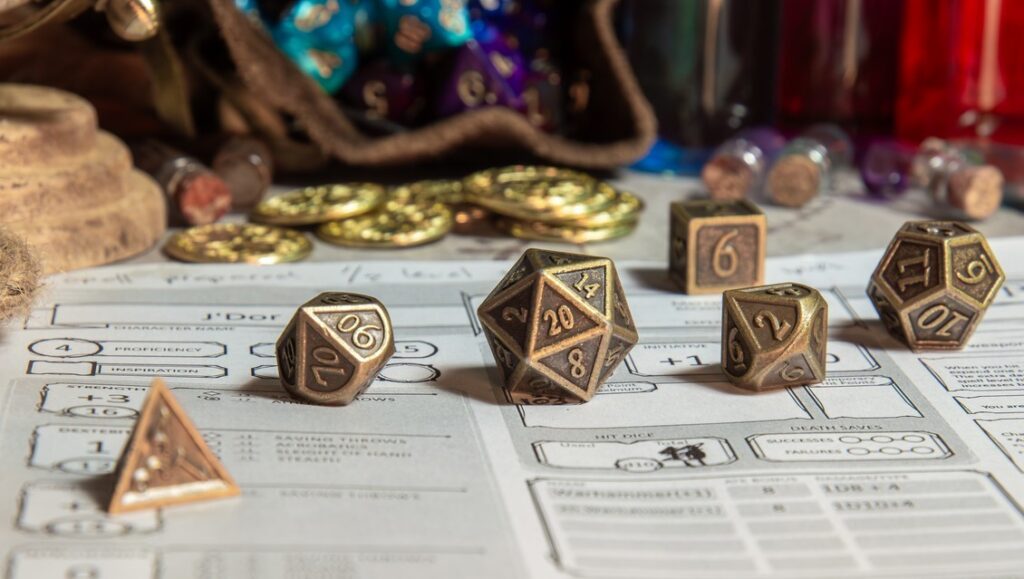
In tabletop RPGs (TTRPGs) such as D&D, a Game Master (GM) leads players through a curated story that involves a combination of scripted character interactions and improvisational scenes. Random outcomes are defined by rolls of the dice and keep games unpredictable and engaging.
There is yet another type of RPG – massively multiplayer online RPGs (MMORPGs), such as World of Warcraft and RuneScape. These games are known for featuring marketplaces and economies, social mechanics like teamwork and trading, long-term character progression, and open-world exploration. In these types of settings, randomness is often introduced by interactions with other players. Games like these can even spill out into the real world: as one crazy example, the world of RuneScape has been helping Venezuelans make a living for years.
You can already start to see the parallels that can be drawn between games and the real world. Consider how the following aspects of RPGs can teach useful lessons about how you manage your money.

Goal-Based Planning
The most direct comparison that can be drawn between RPGs and money in the real world is that, in some way, you will have to save up to buy an item that you need. And when that time comes, you will need to decide between that new sword, a spellbook, and a really cool piece of armor. And if you want all three? Off you go to complete more quests and hunt for more treasure to save up to buy everything.
In the real world, setting goals is a prime way to motivate yourself to save for the future. No matter how trivial the goal may be, by creating a vision for your future, you are training your brain to treasure your future self as much as your present self. This mindset provides the added fuel to trade a bit of today for a better tomorrow.
Opportunity costs are often the reason that players will replay a game more than once. However, life does not present you with chances to revisit decisions you made in the past in the same way. Therefore, it’s crucial to identify your goals and the values that guide your decision-making. The best way to be confident about your choices is to have a clear understanding of what drives them. And, by sitting down and considering the tradeoffs between two potential paths, you can make a clear, informed decision that leaves you with no regret.
Risk Management
RPGs can teach you a lot about managing risk. In games, you are allowed to fail. When you face an enemy you’ve never seen before, it may take you a few tries to understand the best approach, prepare the right weapons, and don suitable armor. Still, you may not ever be fully immunized from the risk of a bad roll of the dice. RPGs help you learn to adapt to situations beyond your control by providing an outlet for the story to continue even if one scene doesn’t go your way.

In life, it can feel like you can’t afford to take the same chances that you do in the world of gaming. Even one misstep can feel catastrophic. Which is why it is important to protect yourself:
- purchase sufficient insurance,
- protect your online identity,
- build an emergency fund, and
- diversify.*
*And talk to your Financial Planning Team member at YeskeBuie if you have any questions about whether you are adequately protected!
Compound Growth
In most RPGs, you start out as the underdog. Your story begins with no money, no experience, no skills, and no understanding of the world in which you find yourself. Progression is slow. It may take hours to level up for the first time, and you may find yourself challenged by the most rudimentary roadblocks.
As time progresses, you gain an understanding of the rules of the game and before long, you feel like you’ve found your footing. You become familiar with the world around you – which areas are safe and which areas remain off-limits – and the rules of the game. You start to build habits that contribute to faster and more sustainable growth: you collect and resell every valuable item you can, you venture further out into the world to face tougher tests, and you invest in new gear that provides more appropriate protection.
By the end of the game, everything feels easy, almost effortless. While the final boss and remaining puzzles may provide a worthwhile challenge, you are at this stage equipped with a sense of confidence and self-worth, buoyed by your understanding of your strengths, your weaknesses, and the resources at your disposal (which, as a result of your hard work, are abundant). Eventually, the story ends, and you’re left wondering why the game ever felt as challenging as it did when you started.
Compare this with the experience of investing. At first, growth is slow and hard to come by. Even the best days in the market feel like an agonizingly slow crawl toward your ultimate goal. But then, as you cross each milestone, you build momentum. “The first $100,000 is the hardest,” they say. But then you have two. Then five, then a million, and so on. By staying the course and continuing to invest in yourself, you find that compounding growth propels you closer and closer to your goals. And, by the time you reach that critical mass and consider yourself financially independent, you wonder how it could ever have come so slowly in the start. Stick with it, stay the course, and your discipline will be rewarded.

It’s About the Journey, Not the Destination
People play RPGs for all sorts of reasons: the challenge, the storytelling, the art styles, the exploration, the teamwork. But regardless of a player’s motivations, the overarching reason they play is to have fun. In group settings, it’s the creativity and teamwork of the players that make the game worthwhile, not the outcome of the dice rolls. And with single-player games, it’s your connection to your character and their story that matters, not the money or experience you accrue.
The same is true with financial planning: building a plan and saving for the future is important, but a plan is useless unless it goes deeper, connecting with the people behind the numbers. This is why YeskeBuie implements a robust Discovery Process that uncovers our Clients’ values, goals, and priorities before we put pen to paper on any financial planning recommendations.
If you have questions about how to build a plan that aligns with who you are, or if you just want to talk to us about your favorite RPGs, please don’t hesitate to contact us!
(And if you’re hungry for more, consider this article with four additional lessons RPGs can teach us about investing.)